

Distance:
7.9 mi.
Elevation:
757 feet
Time:
2h 30m
Camera:
iPhone 17 Pro
The Left Turn at Blue Hen Falls
Sometimes Forgetting Your Camera Is Exactly What You Needed
There’s a little ritual that photographers have before they leave the house. You don’t really think about it anymore because you’ve done it so many times, but somewhere between grabbing your keys and locking the front door you’re mentally checking things off. Camera. Batteries. Memory cards. Water. Tripod? No, don’t need that today. Extra lens? Nah. You just sort of run through everything automatically.
Apparently my brain decided to skip that checklist. About ten minutes into the drive to Boston Mills Visitor Center, I had one of those moments where your stomach just drops. I realized I’d forgotten my camera. Not an extra battery. Not a memory card. The entire camera. My OM-1 was still sitting safely at home while I was halfway to one of my favorite places in Cuyahoga Valley National Park.
For a few minutes I actually debated turning around. If you’ve hiked with me before—or if you’ve read many of these blog posts—you already know that camera has become part of my hiking kit. It’s clipped to my backpack almost every time I hit the trail. At this point I don’t really think about using it anymore. I see something interesting, I unclip it, take the picture, clip it back on, and keep walking. It’s become muscle memory.
Then I started asking myself a different question. Not, “Should I go back?” but rather, “What happens if I don’t?”
Photographers love constraints. It’s almost funny when you think about it. We spend years buying different lenses and different cameras only to intentionally handicap ourselves later. “Today’s a 35mm only day.” “Today’s black and white.” “Today’s one prime lens.” We do it because limitations force us to think differently. So I figured maybe today would just become… iPhone Day.
I have a new iPhone 17 Pro. Other than the occasional snapshot, I really haven’t put it through its paces as a photography tool yet. If there was ever going to be a day where I found out whether it could actually keep up with how I like to shoot, this seemed like as good a day as any. The funny thing is that the longer I drove, the less disappointed I became.
One thing people don’t think about very often is that carrying a dedicated camera changes the way you hike. It’s not the weight. The OM-1 isn’t heavy, and the Peak Design Capture Clip—which, by the way, is one of the greatest pieces of photography gear anyone has ever designed—does an amazing job carrying it. But it’s still there. It still swings a little. It still bumps against your chest every now and then. Every once in a while you instinctively put a hand on it just to stop it from rattling. Plus, today’s hike also happened to be the first time I was going to use trekking poles. Trekking poles plus a camera clipped to your backpack starts feeling like you need a third arm.
So somewhere between Massillon and Boston Mills I made peace with it. The camera wasn’t coming. The phone was going to have to be enough.
A Familiar Beginning
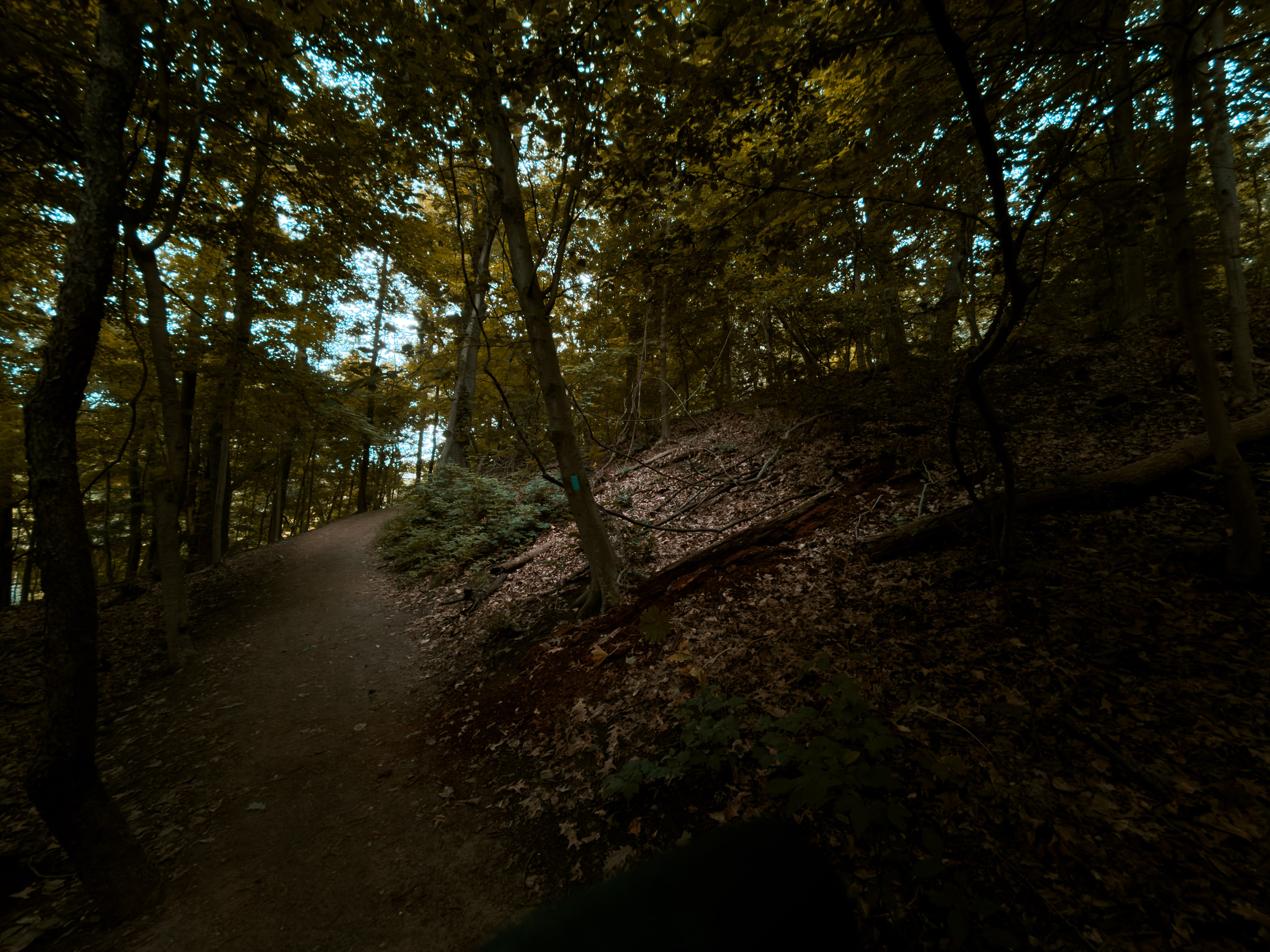 The first mile or so of this hike is completely familiar territory for me. If you’ve ever gone to Blue Hen Falls from the Boston Mills Visitor Center, you’ve already walked this section. I couldn’t tell you exactly how many times I’ve done it at this point, but it’s comfortably into the double digits.
One thing I noticed almost immediately, though, is how differently that first climb felt.
The trail starts by climbing 234 feet in what feels like one long push. I remember when that hill used to tire me out. Now? Now it’s become my rolling start. Every once in a while it’s nice to have those little reminders that you’re stronger than you used to be. Fitness is funny because you almost never notice yourself getting better while it’s happening. You only notice it months later when something that used to be difficult quietly becomes routine. That’s exactly what this hill has become.
The First Choose-Your-Own Adventure
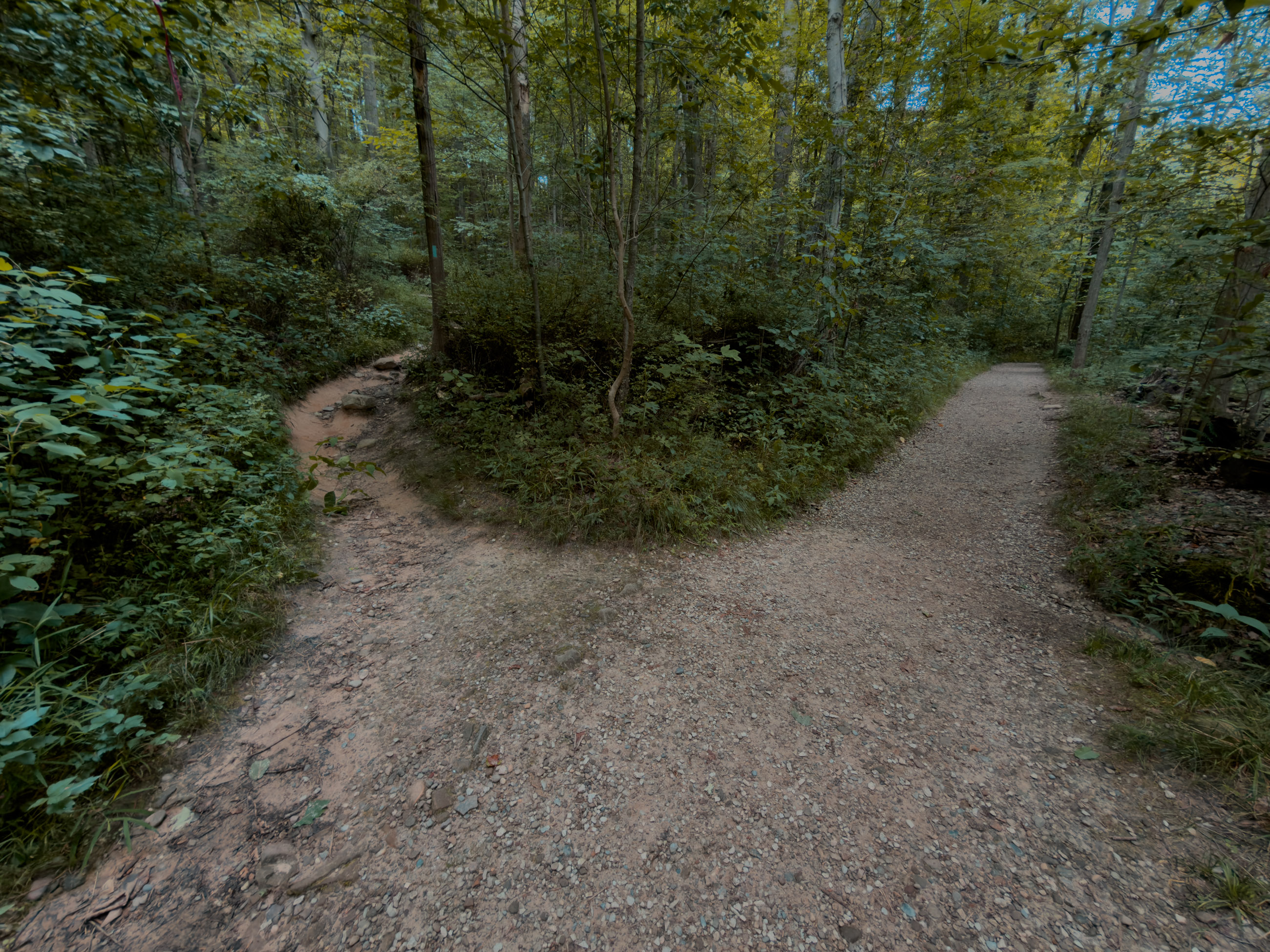
On the left, The Buckeye Trail. The right, Blue Hen Falls.
About 1.2 miles into the hike you arrive at what I’ve started calling the first choose-your-own-adventure.
If you turn right, you’re headed to Blue Hen Falls. It’s a fantastic little waterfall, and if you’ve never been there before, absolutely go. It’s worth it. This time, though, I turned left.
That single decision completely changed the day.
What’s funny is that I’d been to Blue Hen Falls so many times that I honestly thought I knew this area pretty well. It never really occurred to me that I’d somehow ignored an entirely different section of the park simply because I’d always made the same turn.
The difference was immediate. The gravel road toward Blue Hen continues straight ahead. It’s wide, well maintained, and comfortable. The Buckeye Trail… not so much.
It immediately narrows down into a little dirt path that disappears into the woods. Some sections were barely wider than my shoulders. The trail looked worn into the landscape instead of constructed through it, and I absolutely love that.
I’ve realized over the last couple of years that my favorite trails are almost never the popular ones. I like trails where you get the feeling that nature is still winning. Where the path feels just barely maintained enough for people to get through, but if everybody stopped hiking tomorrow the forest would erase it in a season or two. That’s exactly what the Buckeye Trail felt like.
Within a quarter mile the environment was already changing. One minute you’re surrounded by dense canopy. Then the trail opens into a clearing flooded with light before pulling you right back into the woods again. I’ve always loved that effect. It feels like walking through portals. Every time you re-enter the trees it’s like stepping into another room of a much larger forest.
I don’t think I’d ever really appreciated just how much variety existed on this side of the park.
And the funny thing is I’d barely even started.
Into the Unknown
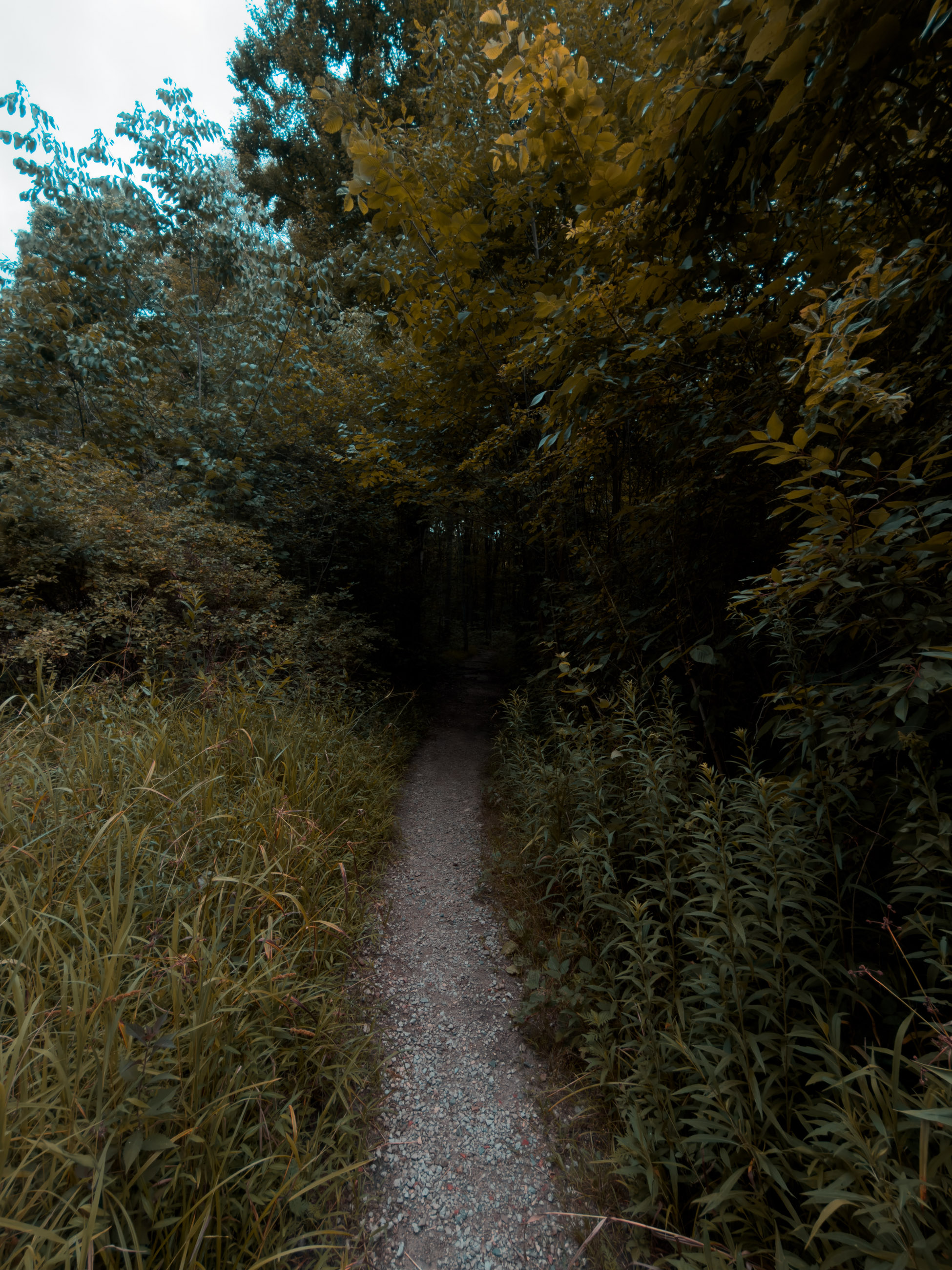
Who doesn’t love a portal into the dark forest?
Trail reviews for this section of the Buckeye Trail all seem to say roughly the same thing. It’s varied. You spend time on ridgelines, then drop down toward the water, then climb back out again. There are forests, streams, little clearings, and enough elevation change to keep things interesting without ever feeling overwhelming. As it turns out, every one of those reviews was right.
Almost immediately after leaving the Blue Hen Falls junction behind, the hike started changing. One minute I was walking beneath dense canopy, then I’d emerge into an opening filled with light before disappearing back into the woods again. I’ve always loved those moments. It feels like walking through a series of natural portals. Every time the trees close back in around you, it feels like you’ve entered another room inside this enormous woodland house.
The terrain was changing just as often. You’d work your way up onto a ridgeline, spend a little time there, then gradually descend toward another drainage before climbing back out again. None of the climbs were especially brutal, but they were frequent enough that the trail never became monotonous. It constantly rewarded you with something new just as you settled into whatever came before it. This also happened to be the perfect place to learn how to use trekking poles.
I should probably admit right now that I had absolutely no idea what I was doing. I’d never watched a tutorial, never read an article, and never bothered looking up “proper technique.” My only experience with poles came from cross-country skiing, so naturally that’s exactly how I started hiking. I’d plant both poles together and push uphill. Was it technically correct? Probably not. Did it work? Yeah, pretty much.
The first thing I noticed was that climbing became easier. Not dramatically easier, but enough that I could tell my upper body was finally contributing instead of my legs doing absolutely everything. On steep sections where exposed tree roots had created these natural stair steps, I’d normally find myself reaching for a tree or grabbing a root to help pull myself uphill. Now I simply planted the poles and pushed.
It didn’t take long, however, to realize I’d made one mistake. I’d extended the poles almost all the way because… well… they looked like they should be tall. They shouldn’t. Within the first half mile I shortened them once, then again, then made one final adjustment. That ended up being the setting I’d use for the rest of the hike.
I also gradually abandoned the cross-country skiing technique. Instead of planting both poles together, I found myself naturally using one side of my body at a time. Right pole. Push. Left pole. Push. It actually reminded me much more of rock climbing than hiking. One side commits to the move while the other prepares for what’s next.
Whether that’s the textbook way to do it or not, I honestly don’t know. What I do know is that after about a mile, I stopped thinking about the trekking poles altogether. They’d gone from something I was experimenting with to something I was simply using. That’s usually a pretty good sign.
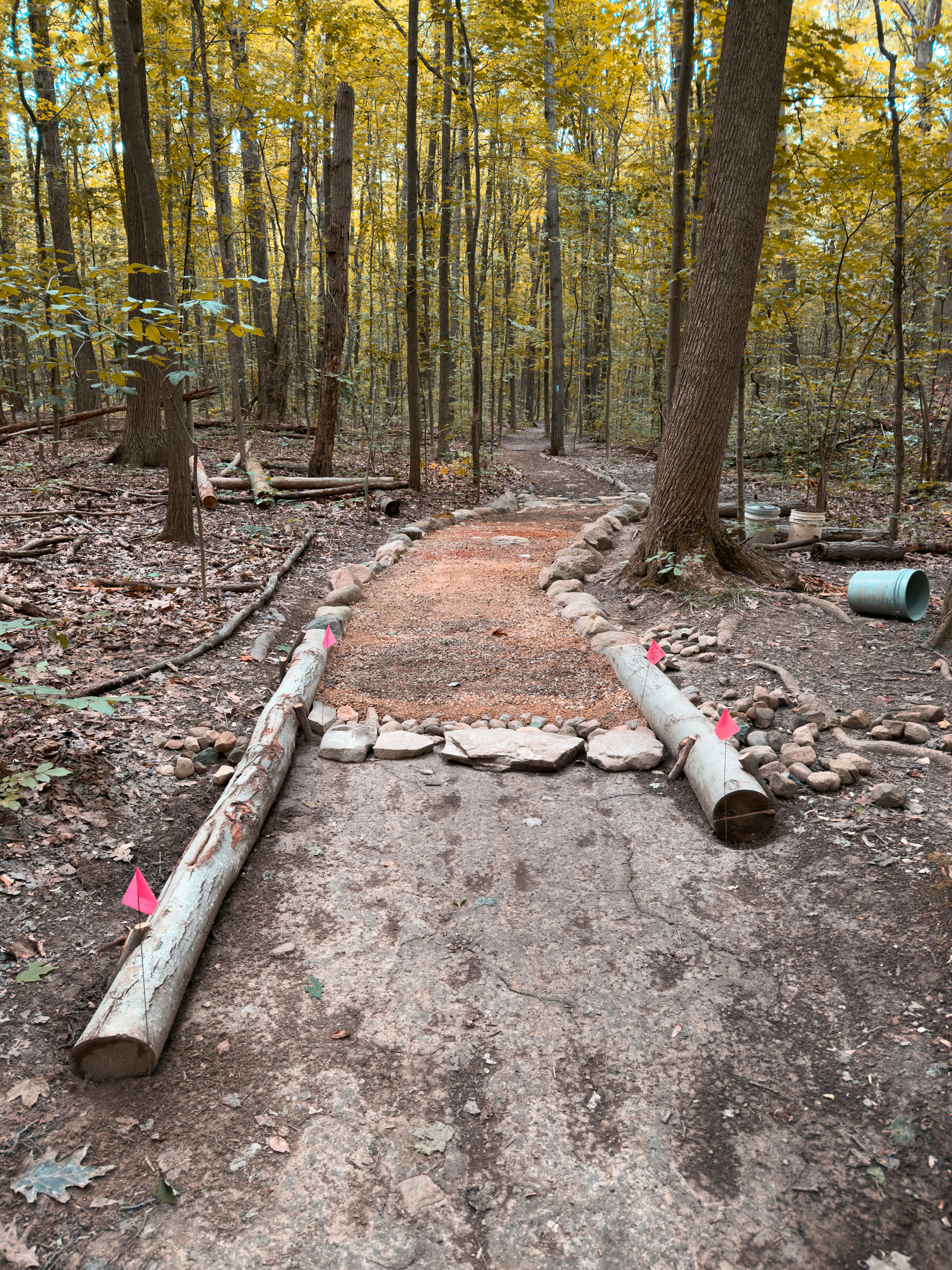
Active trail maintenance.
About a mile and a half into the Buckeye Trail I came across something that made me respect the caretakers of this national park: The Conservancy was actively rebuilding sections of the trail.
Fresh rock had been laid. Timber edging was in place. Equipment was still sitting nearby waiting for another day’s work. I don’t know why I enjoy seeing that sort of thing so much, but I do. It’s one thing to hike through a beautiful forest. It’s another to realize there are people quietly making sure that forest stays beautiful.
What I appreciated most was that they weren’t widening the trail or making it feel more developed. They were simply fixing the places where water naturally wanted to win. Muddy sections have a habit of growing over time because hikers instinctively walk around them. The trail slowly becomes wider and wider until the forest starts losing ground.
Seeing those trouble spots reinforced instead of expanded was a nice reminder that maintaining a trail isn’t just about making it easier to hike.
It’s about protecting everything around it.
The Creek I Didn’t Know I Was Looking For
One of the things I love most about trails like this is that they don’t announce the good parts. There’s no sign that says, “Scenic Overlook Ahead.” No bench. No parking lot. No crowd of people taking selfies. The Buckeye Trail just quietly continues doing its thing until, before you realize what’s happening, you’re somewhere special.
About two and a half miles into the hike, the trail begins working its way back down toward another tributary of the Cuyahoga River. If you’ve ever spent time around Spring Creek—the creek that feeds Blue Hen Falls—you’ll recognize this one immediately. It’s about the same size, the same character, and carries itself with the same quiet confidence that seems to define so many of the little waterways throughout the park.
Long before I reached it, I could hear it. That’s one of those little pleasures that hiking gives you. The forest starts whispering about what’s ahead before you can actually see it. The farther I descended, the louder the water became until eventually the trees opened just enough for the creek to appear.
It was beautiful. Not dramatic. Not roaring. Just… beautiful.
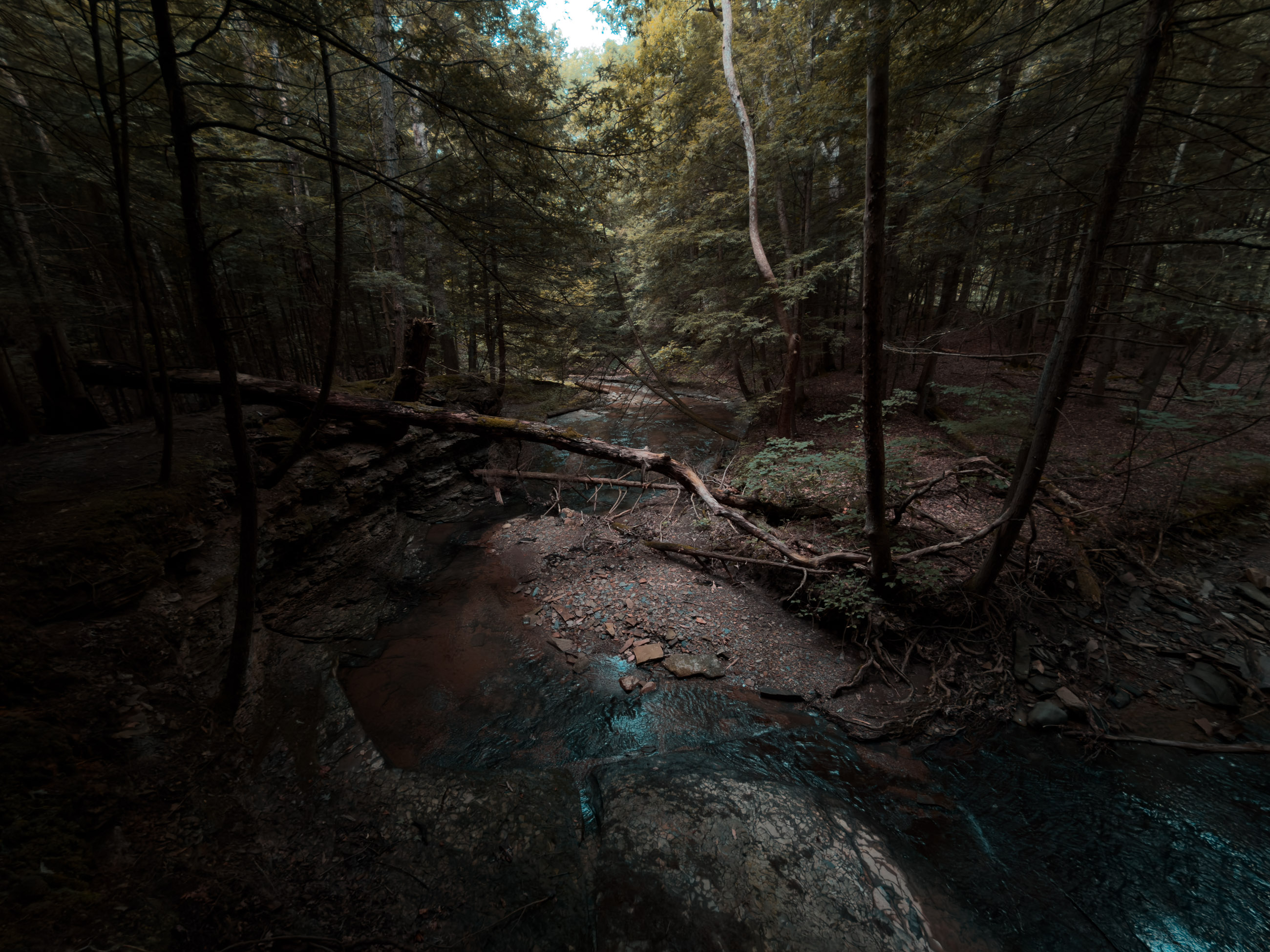
This was the most beautiful scene I came across this day and it blew me away.
Recent rains had spread the water across nearly the entire creek bed. Instead of one defined channel, the water was only about half an inch deep in most places, but it covered almost everything. The shale beneath it glistened, and every little ripple reflected bits of sunlight filtering through the trees overhead.
It was one of those places where you instinctively slow down.
Crossing it also gave me a chance to appreciate my footwear a little more than I expected.
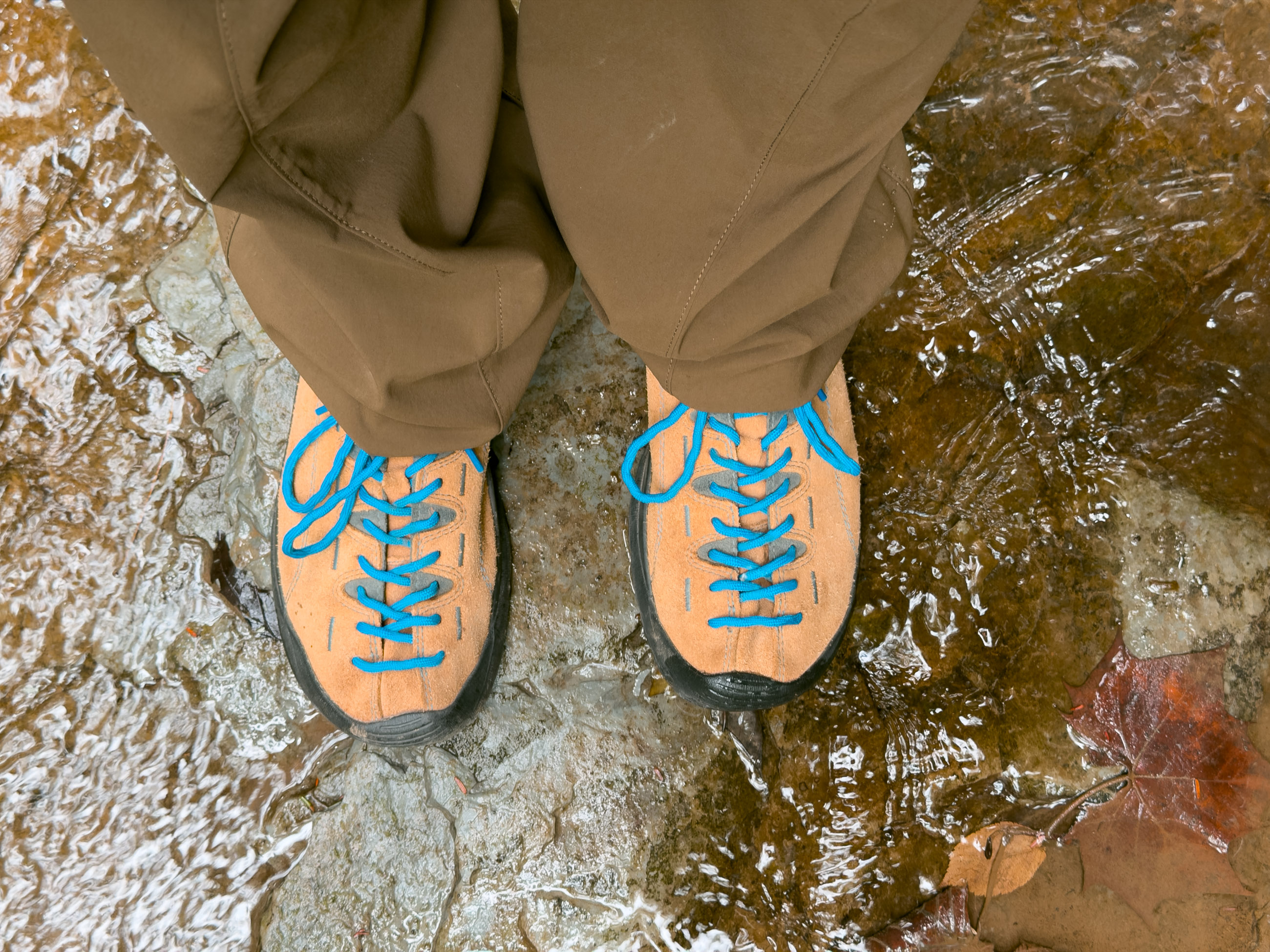
The Keen Jasper shoes earning their keep out here on the trail.
Keen sells the Jasper as a casual shoe, but every time I wear them on trails like this I’m reminded how much they feel like the old approach shoes I grew up admiring. The rubber grips incredibly well, and even on wet shale I never felt uncertain about my footing. Muddy sections earlier in the hike hadn’t bothered them, and the creek crossing didn’t either. I always appreciate gear that quietly does its job without demanding attention, and today the Jaspers were exactly that.
After crossing the creek, the trail began climbing again, but before I really started paying attention to the hill, something else stopped me.
There are moments on hikes that photographs simply cannot explain.
This was one of them.
The trail curved along the hillside above the creek, and suddenly the forest opened just enough for me to look down into a bend in the water below. Shafts of sunlight filtered through the canopy and landed on moss-covered rocks that almost seemed to glow. Everything was impossibly green. The creek bent lazily through the forest as though it had absolutely nowhere important to be.
It honestly felt like something out of a fairy tale.
I know that’s an overused phrase, but I don’t really know how else to describe it. Every once in a while you stumble into a place that feels… enchanted. Not because anything extraordinary is happening, but because everything ordinary happens together in exactly the right way. The light. The water. The quiet. The smell of damp earth. Even the temperature seemed different there.
Losing the Trail
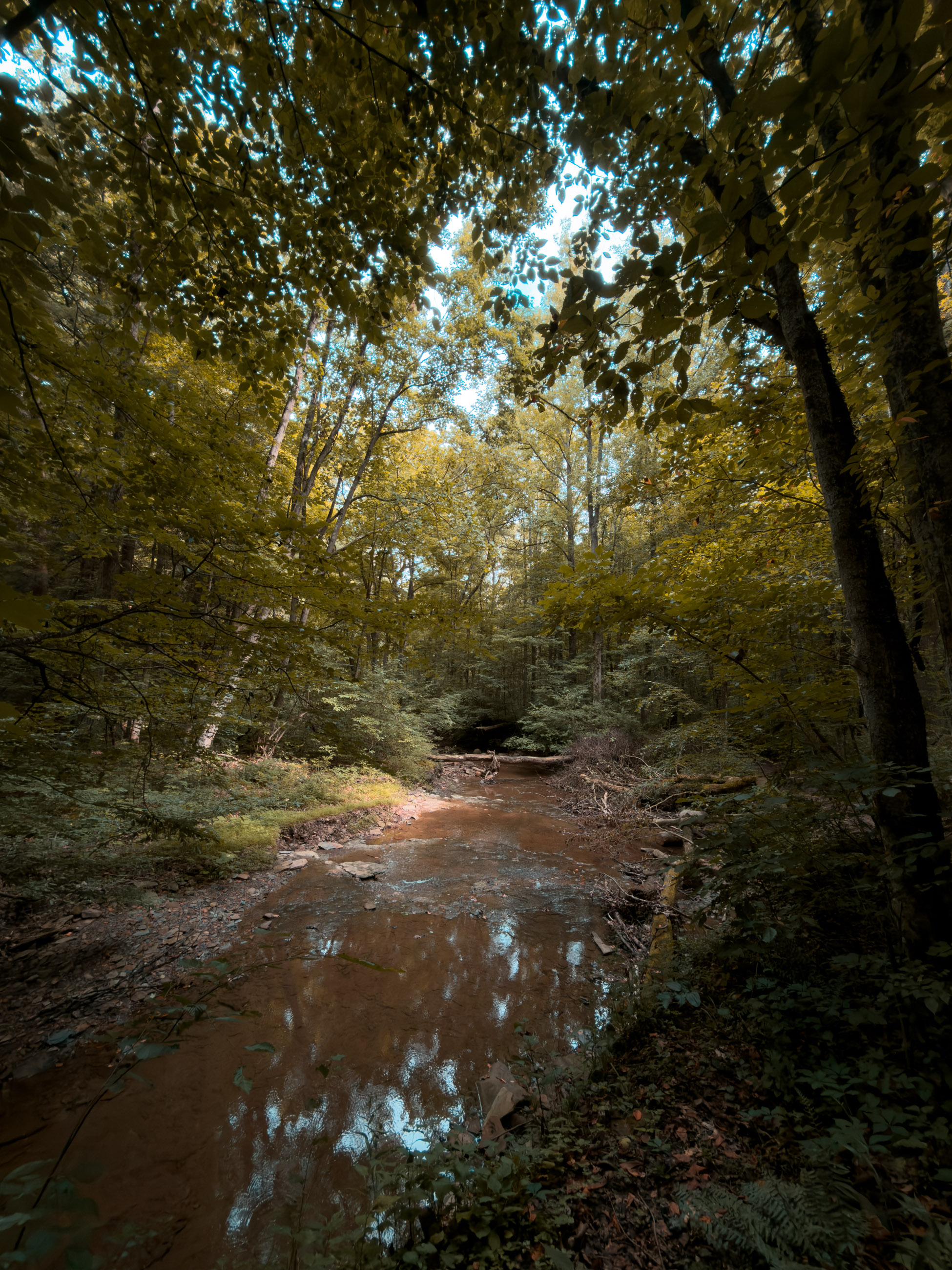 One of the nice things about hiking unfamiliar trails is that every once in a while you’re reminded that nature doesn’t particularly care where humans intended the path to be. A little further down the Buckeye Trail, somewhere around the 3.2-mile mark, I found exactly that reminder.
Like several times before, the trail dropped off the ridgeline and headed back toward another creek crossing. By now I’d learned the pattern. Down into the drainage. Cross the water. Back up the other side. Except this time the trail more or less disappeared.
Between recent rains, flowing water, exposed rock, and years of erosion, the bottom of the ravine looked less like a hiking trail and more like nature had decided to hit the reset button. There were hints of a path, but nothing obvious. It honestly looked like the forest was doing exactly what forests are supposed to do—slowly erasing every trace that people had ever been there.
Fortunately I had AllTrails running, so I wasn’t worried about getting lost. I knew the general direction I needed to travel. I just didn’t know exactly where to put my feet.
Eventually I spotted what looked like a rough staircase of rocks climbing the opposite hillside. It wasn’t marked. It wasn’t obvious. It looked right. So I crossed the creek, started climbing, and within a few steps found myself wondering if I miscaulculated.
The trail had become incredibly narrow. Wet leaves covered everything, the recent rains had softened the soil, and what little tread existed seemed to disappear every few feet.
I actually laughed and said out loud, “Is this even the trail?” Almost as if the park had been waiting for exactly that question, I looked up the hill and saw another hiker coming toward me. The first person I’d seen in what felt like forever. I immediately followed up my own question with, “Yep… this is the trail!” I’m not even sure if he heard me, but we exchanged a quick hello as we passed each other and continued in opposite directions.
Those little interactions are funny. You don’t know each other’s names. You’ll probably never see each other again. But for five seconds you’re both participants in exactly the same adventure.
Going Up Is Easy. Going Down Is Humbling.
That climb out of the creek ended up becoming the biggest test yet for my trekking poles. Going uphill? I was completely sold. The poles let me stay in rhythm, and I could feel that they were taking just enough work away from my legs that I wasn’t burning through energy nearly as quickly as I normally would.
Coming downhill… That was a completely different story. What I learned almost immediately is that trekking poles don’t replace good footwork. There was one muddy descent where I found myself paying more attention to where I was planting the poles than where I was placing my boots. The result was exactly what you’d expect. I slid. Nothing dramatic. Just three feet of unplanned skiing through mud before regaining my balance. No harm done. A very polite reminder from the trail that my feet should always be making the important decisions. Regardless, by the time I reached the top of the hill, I trusted the trekking poles more than I had an hour earlier. They’re incredible tools. I’m excited to see if I can use them better as I put more time in with them
The Forest Finds Its Rhythm
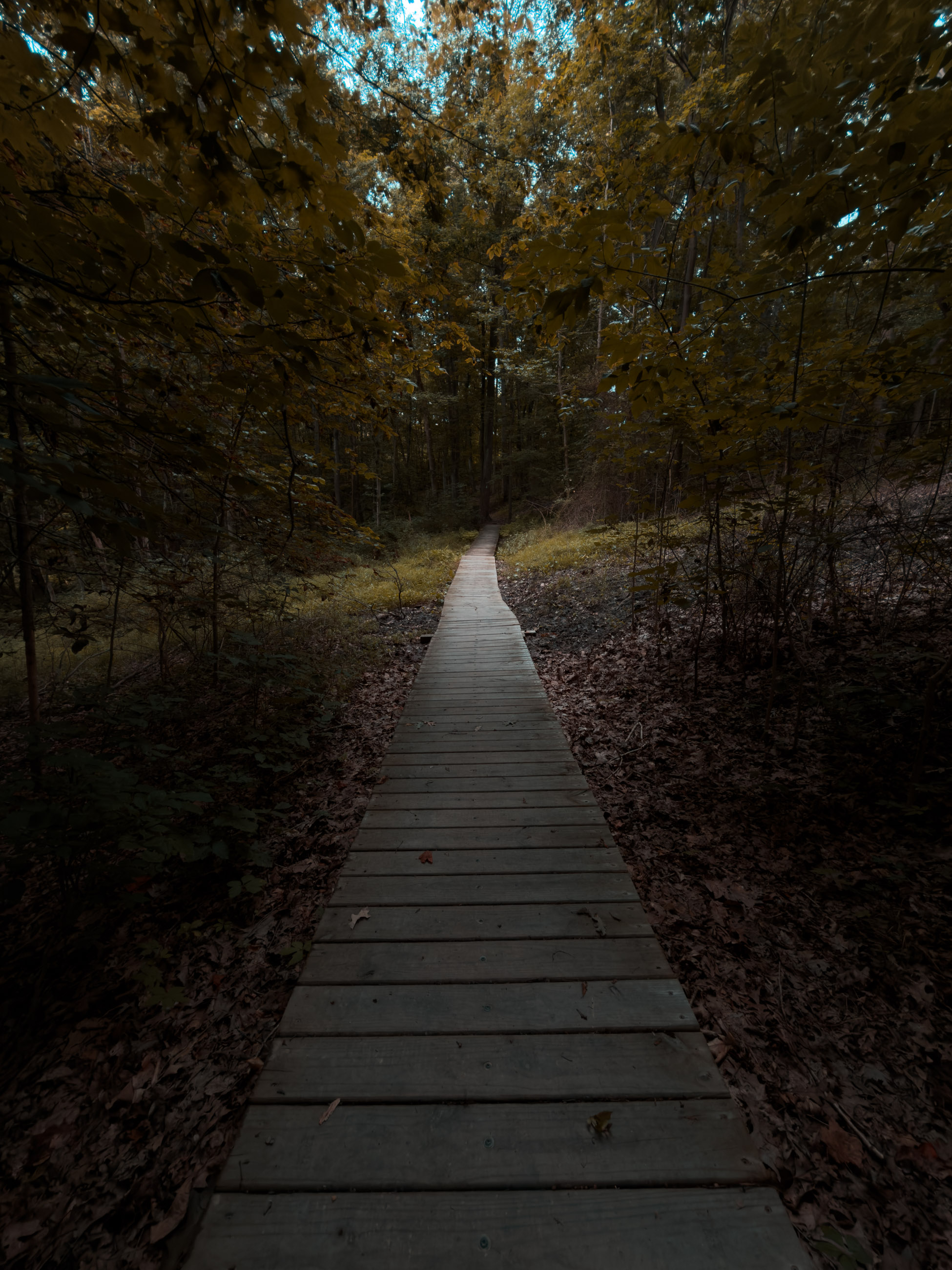 Once I climbed back onto the ridgeline, the hike settled into a different pace. The dramatic climbs and creek crossings began spacing themselves farther apart, and for a while it felt like the trail was simply inviting me to walk. Not every section of a hike needs to be spectacular. Some sections exist to let your mind wander. This was one of those sections.
The Buckeye Trail meandered quietly through the woods, occasionally reminding me that people still cared for this place. A beautifully built footbridge crossed a small drainage, blending into the forest so naturally that it almost felt like it had always belonged there. It wasn’t flashy. It wasn’t trying to become a destination. It simply solved a problem and protected the trail beneath it. I appreciate things like that.
Good trail work shouldn’t pull your attention away from the forest. It should quietly disappear into it. Over nearly two hours on the Buckeye Trail, I only encountered four other people.
Four.
In one of the most visited national parks in the country, that’s remarkable. It meant I spent most of the morning listening to birds instead of conversations, wind instead of traffic, and my own thoughts instead of everybody else’s. That’s becoming rarer these days. And it’s one of the reasons I already knew I’d be coming back.
Back to Civilization… Sort Of
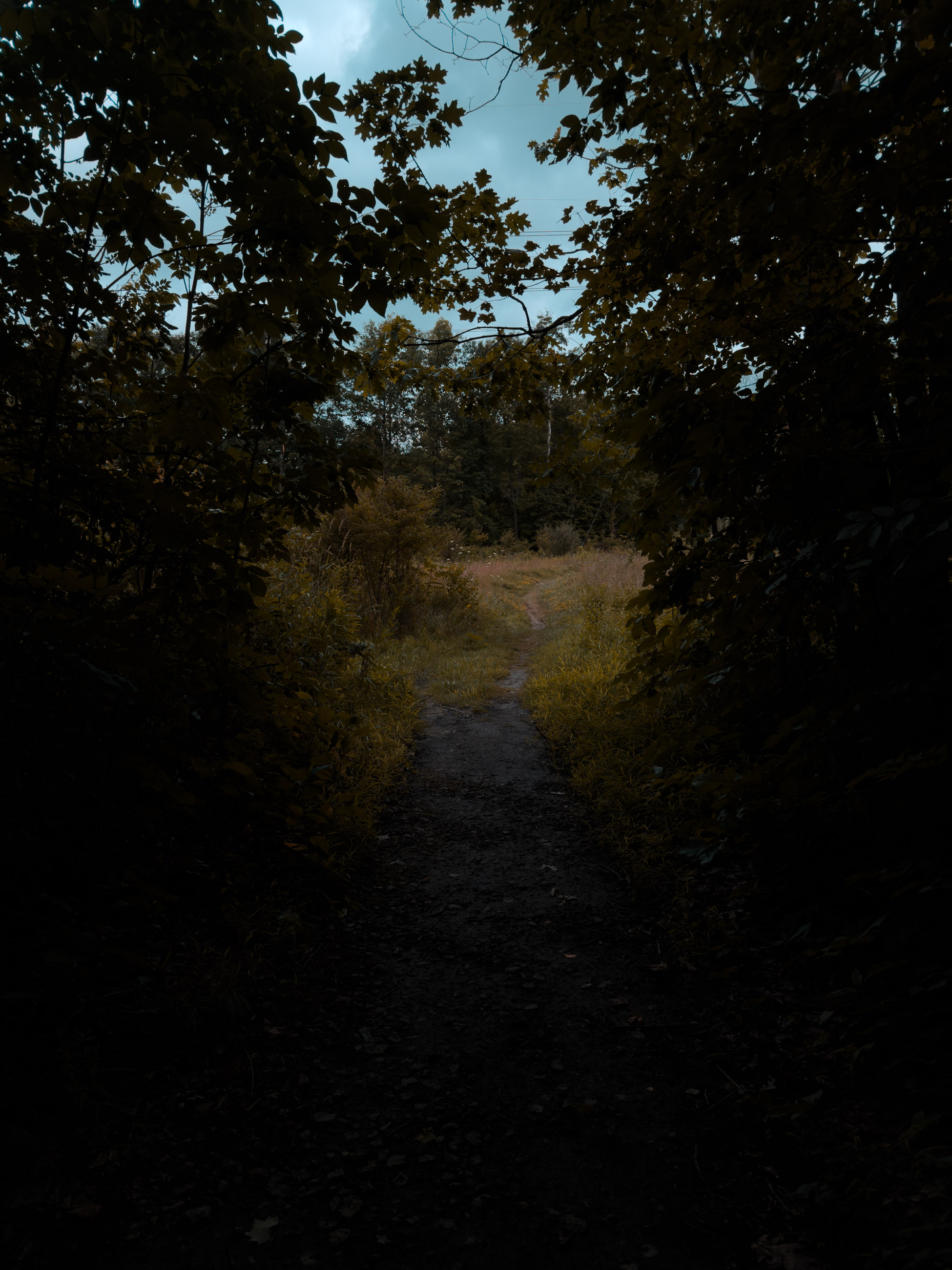 The Buckeye Trail had already taken me through ridgelines, creek crossings, moss-covered ravines, dense forest, and enough elevation changes to keep things interesting without ever becoming exhausting. Somewhere around the 3.7-mile mark, though, the trail began changing again. The climbs mellowed out. The terrain became gentler. Instead of constantly asking me to climb or descend, it simply asked me to keep walking.
I actually like sections like this. Not because they’re the most exciting part of a hike, but because they give your brain time to process everything you’ve already experienced. Hiking isn’t supposed to be a highlight reel every fifty feet. Sometimes the trail is simply carrying you toward whatever comes next, and there’s something peaceful about that. I wasn’t bored. I wasn’t wishing the next landmark would hurry up and arrive. I was just… hiking. Sometimes that’s enough.
One thing that continued to impress me, though, was how much care was going into this section of trail. Before long I came across a brand-new wooden bridge spanning one of the little drainage ravines that cut through the hillside. It wasn’t a dramatic bridge. It wasn’t trying to become an attraction. It simply solved a problem elegantly. Water gets to keep flowing where it wants to flow. Hikers get to keep walking where they’re supposed to walk. The forest doesn’t slowly lose ground to widening muddy trails.
A Doorway of Light
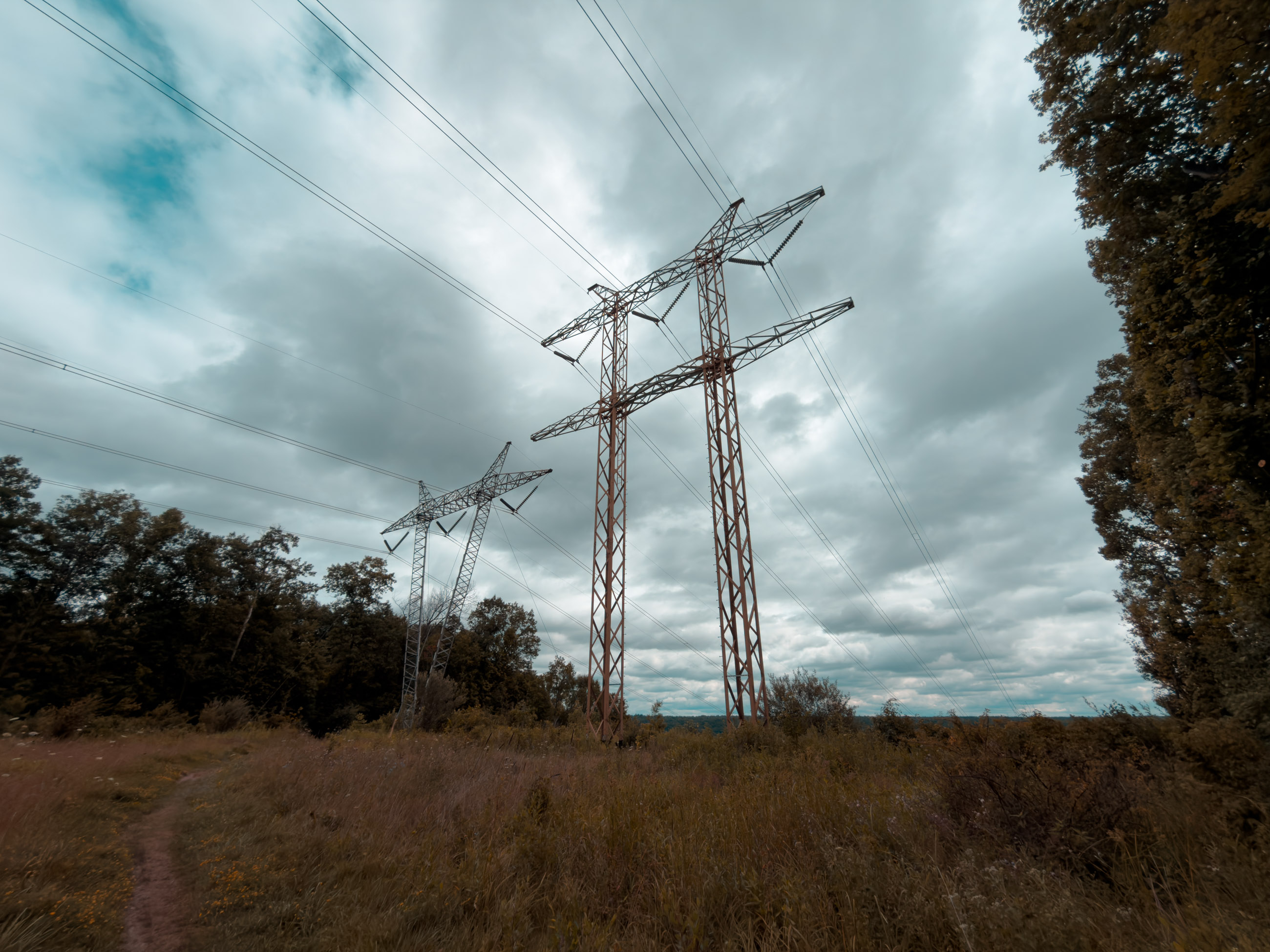 Eventually the trees opened. Not gradually. Suddenly. One minute I was completely enclosed beneath the canopy, and the next I stepped into one of those massive utility corridors where the power lines cut a wide opening through the forest.
Normally I’d think something like that would ruin the mood. Instead it was kind of beautiful. After spending hours inside green tunnels, suddenly being surrounded by sky again felt refreshing. The transmission towers stretched overhead while this tiny dirt path—barely wide enough for a single person—continued confidently across the opening before disappearing right back into the woods on the other side. It almost looked cinematic.
What I loved most wasn’t the power lines. It was the contrast. You spend so much time feeling enclosed by the forest that the sudden openness almost feels shocking. Then, just as quickly as it appeared, it’s gone again, and you’re swallowed right back into the trees. The Buckeye Trail seemed to delight in changing its personality every twenty minutes. I never knew exactly what the next bend would bring.
Solving an Old Mystery
Eventually the trail emerged onto Snowville Road. I looked around, completely confused as to where the heck I was – I had no idea! But as soon as I checked AllTrails, I suddenly realized, oh my God, how did I miss this last year? Like, I obviously have no concept of how to read a map. Apparently, my ignorance knows no bounds.
The Connector
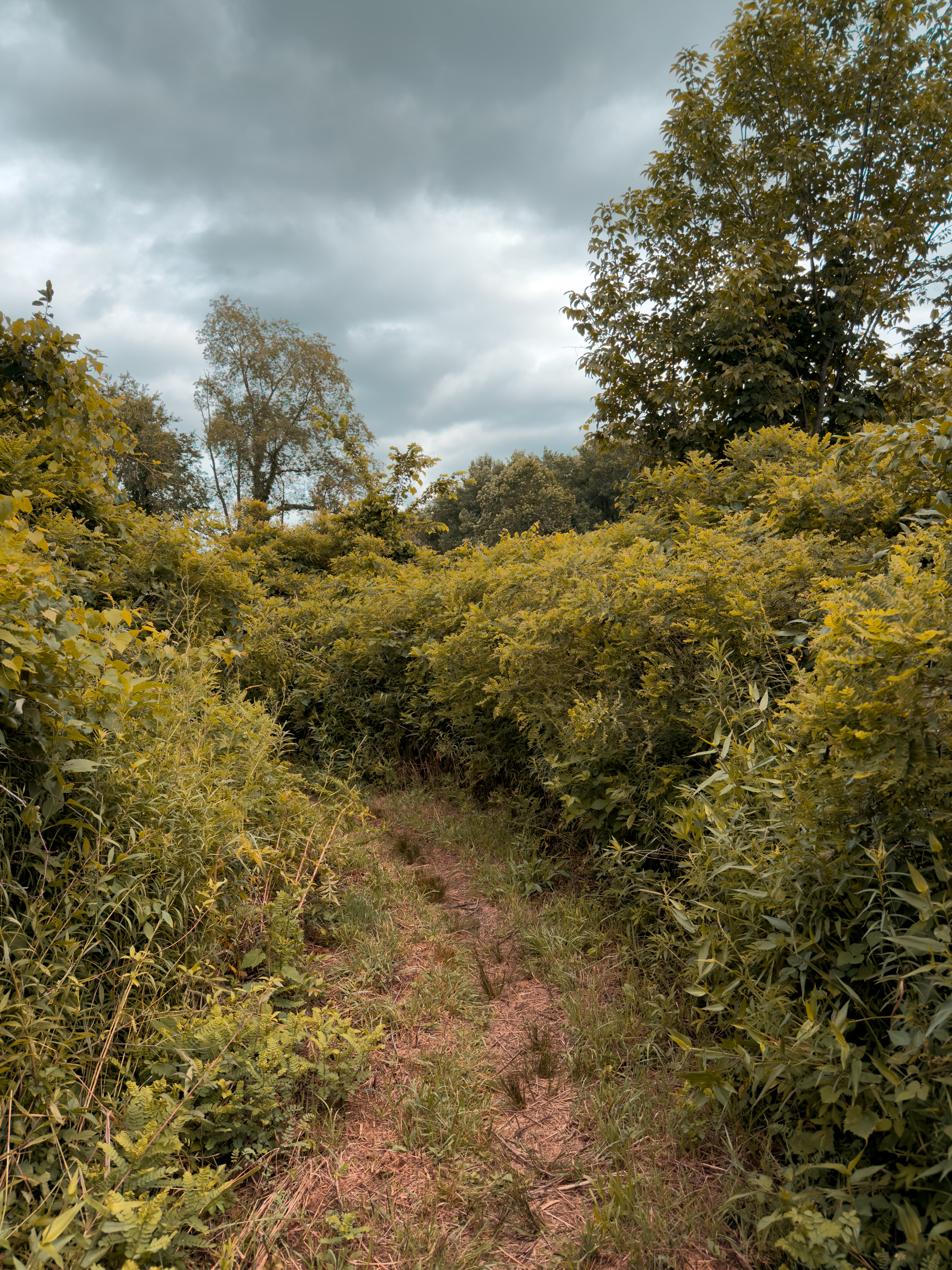 Snowville Road only lasts for a couple tenths of a mile before another little trail disappears back into the woods. This one is called the Connector Trail. It seems so goofy to admit this but, I loved it.
It’s only about half a mile long, but it has a completely different personality than everything that came before it. First you cross the railroad tracks – which, if you know me, already earns bonus points because I’ve always had a soft spot for trains and infrastructure. Then the trail narrows again as the vegetation begins to assert its dominance.
Tall grasses and dense growth rise up on both sides until you’re essentially walking through a living hallway. Eight-foot walls of green surround you while this little dirt ribbon quietly threads its way toward the Towpath. I couldn’t stop thinking how quickly nature would reclaim this place if people stopped walking here. How many hikers does it actually take to keep this trail alive? Left alone for a season or two, I have no doubt this entire corridor would disappear beneath the overgrowth.
That thought made it feel strangely post-apocalyptic. Like I was following one of the last remaining footpaths through a world nature had decided to take back. When I was a kid, I probably would’ve imagined I was sneaking through some forbidden garden or exploring territory behind enemy lines. Honestly, I don’t think I’ve changed very much. The imagination is still there. The only difference now is that I call it hiking instead of pretending.
The Connector also gave my trekking poles another unexpected job. The vegetation leaned into the trail constantly, brushing against my shoulders and arms. Instead of walking directly through all of it—and whatever ticks might have been waiting—I found myself gently pushing the grasses aside with the poles as I walked. I hadn’t expected trekking poles to double as portable tick negotiators. I’ll happily take it.
A few minutes later the Connector emptied onto the Towpath. The forest adventure was over. Or so I thought.
The Towpath Gets a Bad Rap
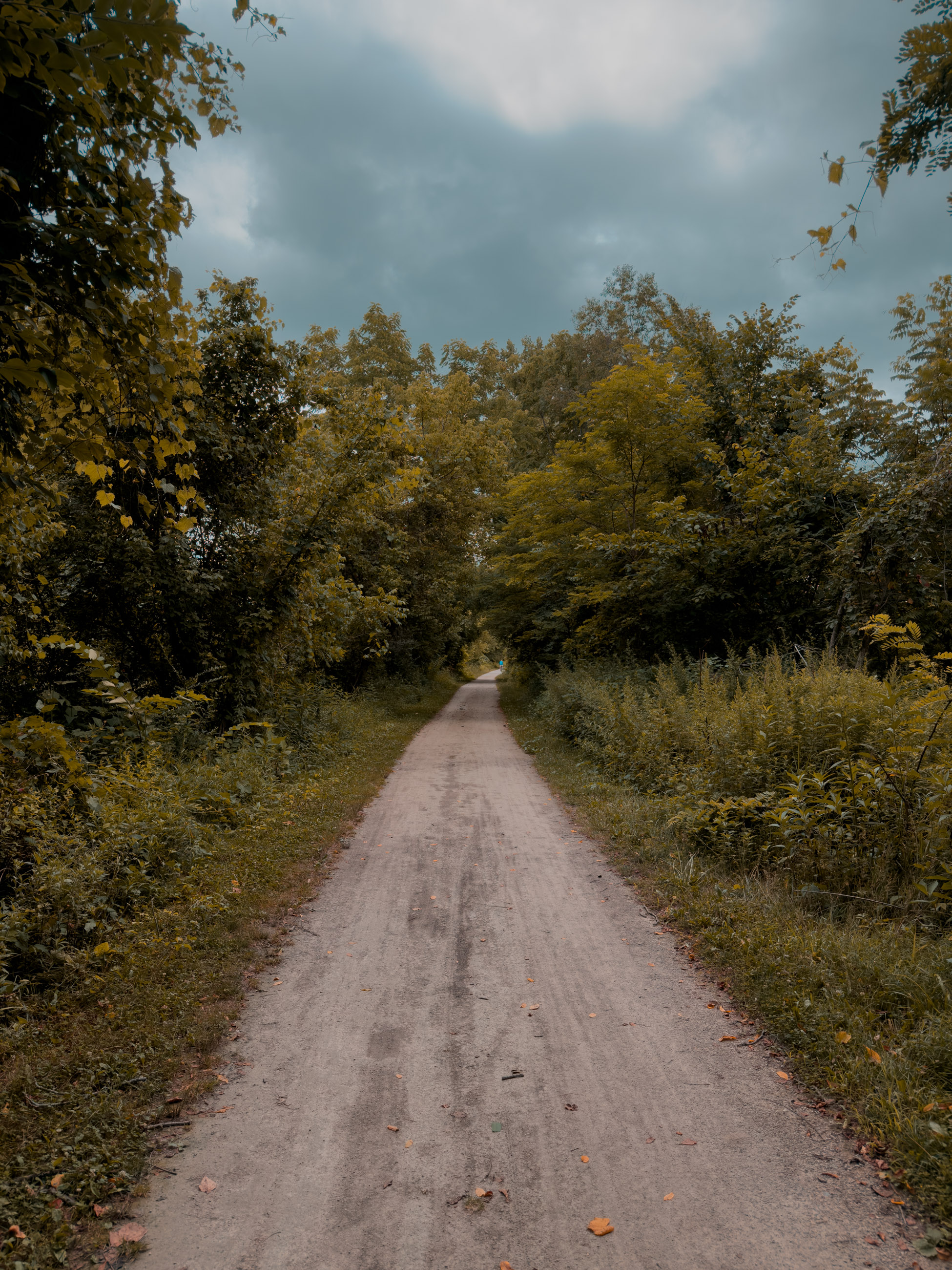 I think the Towpath is one of the most misunderstood parts of Cuyahoga Valley National Park. Go read enough reviews and eventually you’ll run into somebody saying something like, “The Buckeye Trail was awesome, but then you have to walk the Towpath back.” They make it sound like it’s the penalty box you have to sit in before you’re allowed to go home. I don’t really understand that criticism. The Towpath isn’t trying to be the Buckeye Trail.
The Buckeye Trail keeps you busy. You’re constantly watching your footing, climbing over roots, crossing creeks, figuring out where the trail went after the last rainstorm tried to erase it. The Towpath doesn’t ask any of that from you. It’s flat. It’s wide. It lets you stop thinking about where you’re putting your feet and start paying attention to everything else.
One of the first things I noticed after stepping onto the Towpath was a couple guys getting out of a car. One of them immediately started walking while the other guy was stretching, obviously getting ready for a run. My brain immediately decided that the first guy and I were now competing. He had absolutely no idea this competition existed, but that didn’t matter. He had fresh legs. I’d already hiked over six miles. I figured I could catch him anyway.
I did. He lost a race he never knew he was running. Poor fella.
Looking Through Keyholes
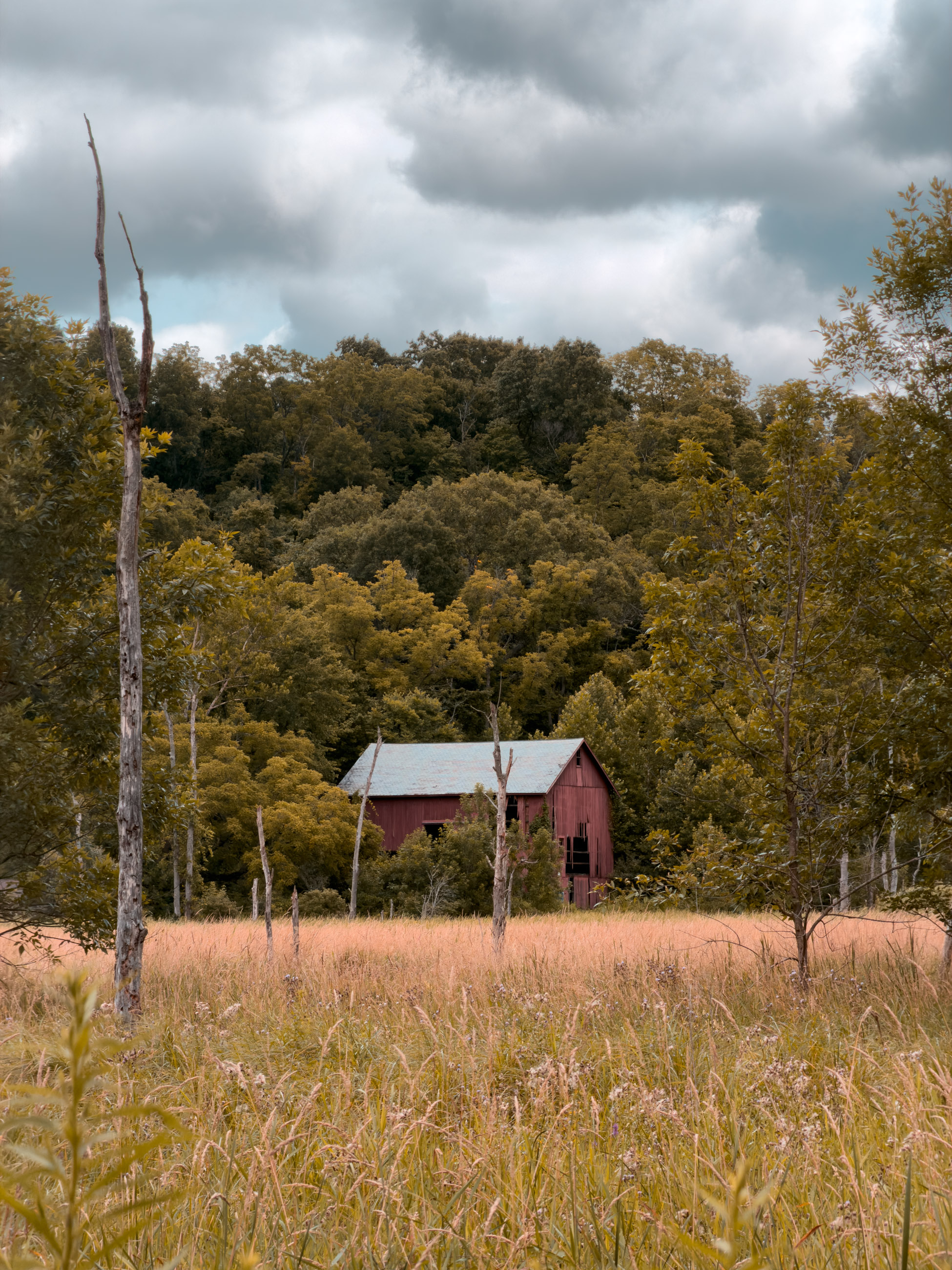 The Towpath has a rhythm that I think a lot of people miss. Most of the time you’re surrounded by trees, and then every so often the forest opens up for twenty or thirty feet before closing again. Those little openings became my favorite part. Sometimes they’d reveal the Cuyahoga River bending around another corner with driftwood piled up along the banks. Other times I’d be looking across open prairie, or tall grasses, or an old barn sitting way off in the distance. You never really get the whole landscape at once. The trees just hand you little pieces of it before taking it back again.
I started thinking of those openings as keyholes.
The other thing I always enjoy about the Towpath is remembering what it actually is. It’s easy to think of it as just another bike trail because that’s how most people experience it now, but that’s not why it exists. Long before trucks and highways, this was infrastructure. Canal boats moved freight through here because dragging everything around Ohio with wagons wasn’t exactly efficient. The canal itself is mostly gone now, but the locks are still there, the old channel is still visible in places, and if you stop for a minute it’s not that hard to picture what this valley must have looked like a hundred and fifty years ago. I don’t spend a ton of time thinking about history every day, but when it’s literally sitting beside the trail you’re walking on, it’s hard not to appreciate it.
By the last mile or so my legs had officially started filing complaints. The tops of my thighs were cooked. My calves were cooked. Even the muscles around my knees had decided they were done cooperating. None of that really mattered because I knew exactly where I was going. The only objective left was getting back to the car without stopping. I’d pushed the pace all day, and I wasn’t about to start negotiating with myself over the last mile and a half.
One More Thing
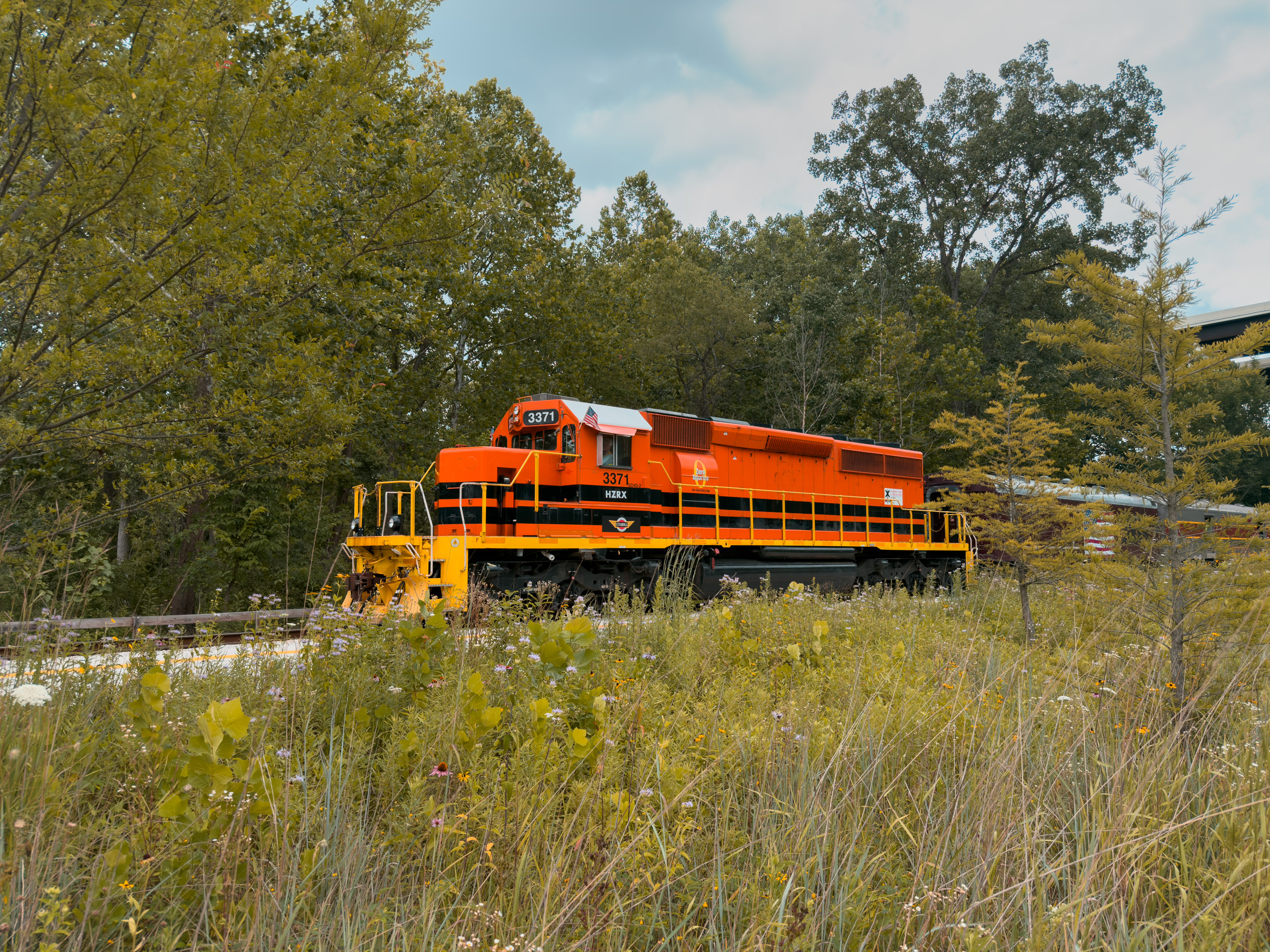 When I finally got back to Boston Mills Visitor Center, I climbed into the car, shut the door, and just sat there for a second. The hike was over. My legs hurt. I was checking my stats on AllTrails when I heard a train horn off in the distance.
If you’ve spent much time in Cuyahoga Valley, you already know that horn. The Scenic Railroad.
I got right back out of the car, grabbed my phone, and started walking toward the tracks. A few seconds later that bright orange locomotive rolled through the valley exactly as if somebody had planned the timing around my hike. Obviously they didn’t, but I wasn’t about to complain.
What can I say, as a kid I was a little boy who thought trains were cool, and now I’m an adult who still thinks trains are cool.
So, to recap: I’d forgotten my camera, learned how to use trekking poles, accidentally found one of the prettiest sections of trail I’ve been on in Cuyahoga Valley, proved to myself that I could move a faster than some random unsuspecting dude, and then, just before driving home, I got to watch a bright orange train roll through the valley.
I’ll take that ending every single time.